
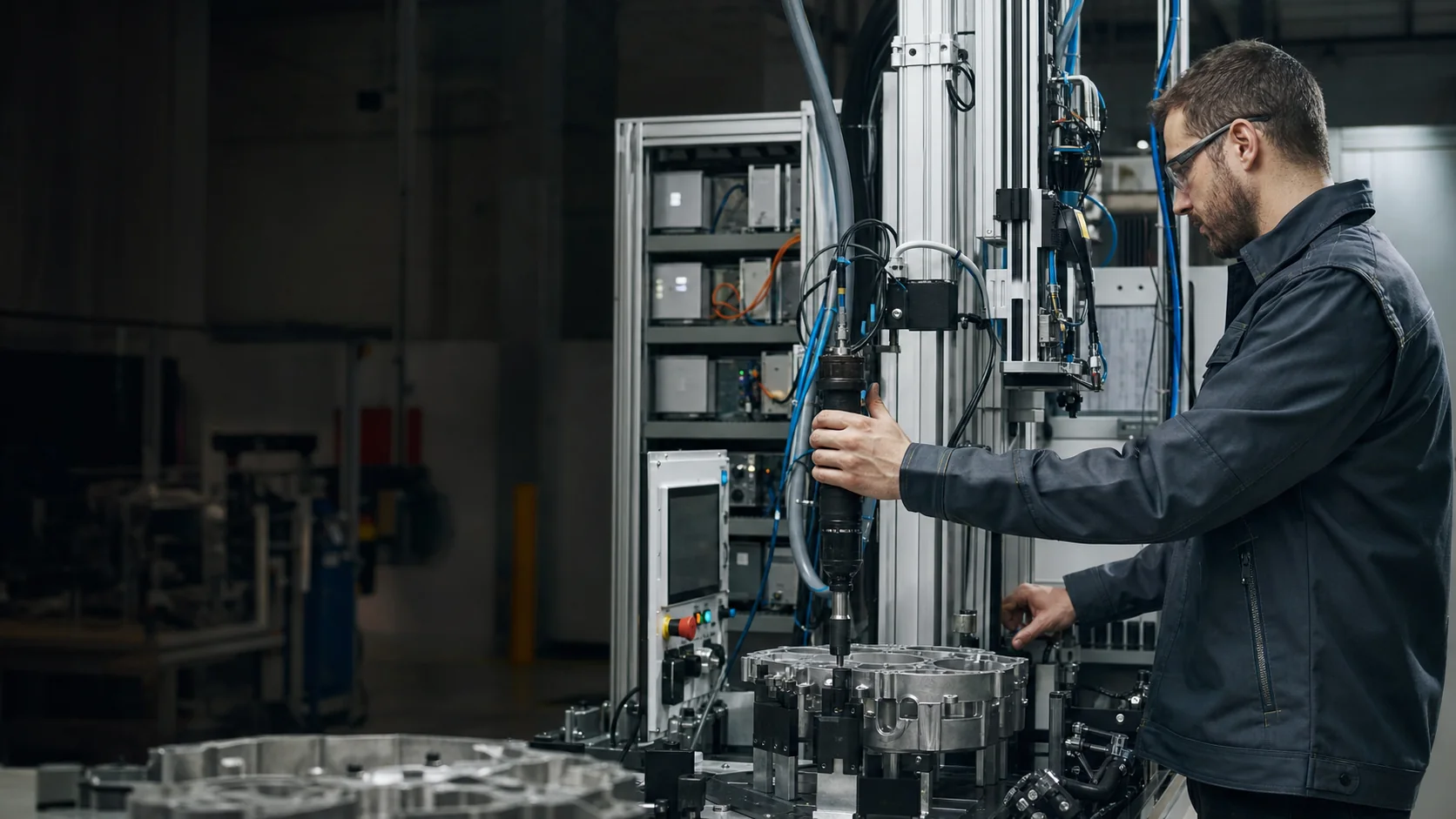
Machine and tool connectivity
Capture the result at its source.
Connect machines and tightening tools to the correct product, operation and acceptance rule.
A tool result without context is only a number.
The integration must know which product is present, which operation is authorized and what should happen when the result is missing or rejected.
Mixed equipment
PLCs, test benches, sensors and tools expose different protocols, structures and lifecycle constraints.
Wrong association
A valid result can still be attached to the wrong serial number, operation or program.
Silent interruption
Networks, controllers and upstream systems fail. Buffering and recovery must preserve sequence and evidence.
Support gap
Without diagnostics and procedures, maintenance teams cannot distinguish equipment, network and application faults.
The connection is designed as a production transaction.
Each flow covers identity, authorization, execution, result capture, acknowledgement, exception and recovery.
Equipment assessment
Protocols, controller capabilities, data points, network constraints and vendor interfaces.
Context contract
Product, order, operation, program, tool, result and acceptance relationships.
Edge integration
Kepware, OPC UA, MQTT, APIs or vendor protocols selected for the equipment and plant standard.
Failure handling
Timeouts, duplicates, buffering, replay, rejected results, diagnostics and manual recovery.
Production validation
Normal and abnormal scenarios tested with engineering, quality, operations and support teams.
Operational handover
Configuration, monitoring, troubleshooting, recovery and change procedures.
Equipment and protocols in scope.
Tightening tools
Atlas Copco, SCS, HST and comparable controller-based assembly systems.
Industrial assets
PLCs, test equipment, sensors, gateways and legacy machines.
Connectivity
OPC UA, MQTT, Kepware, vendor APIs, databases and file-based interfaces where required.
Consumers
MES, ThingWorx, UNS brokers, quality applications, time-series stores and enterprise systems.
Connect one machine flow correctly.
Share the equipment, target system and production decision the result must support.